
AI deployment is not transformation
Deloitte's latest AI transformation research makes the operating gap clear: AI being present in a company is not the same as work actually changing.
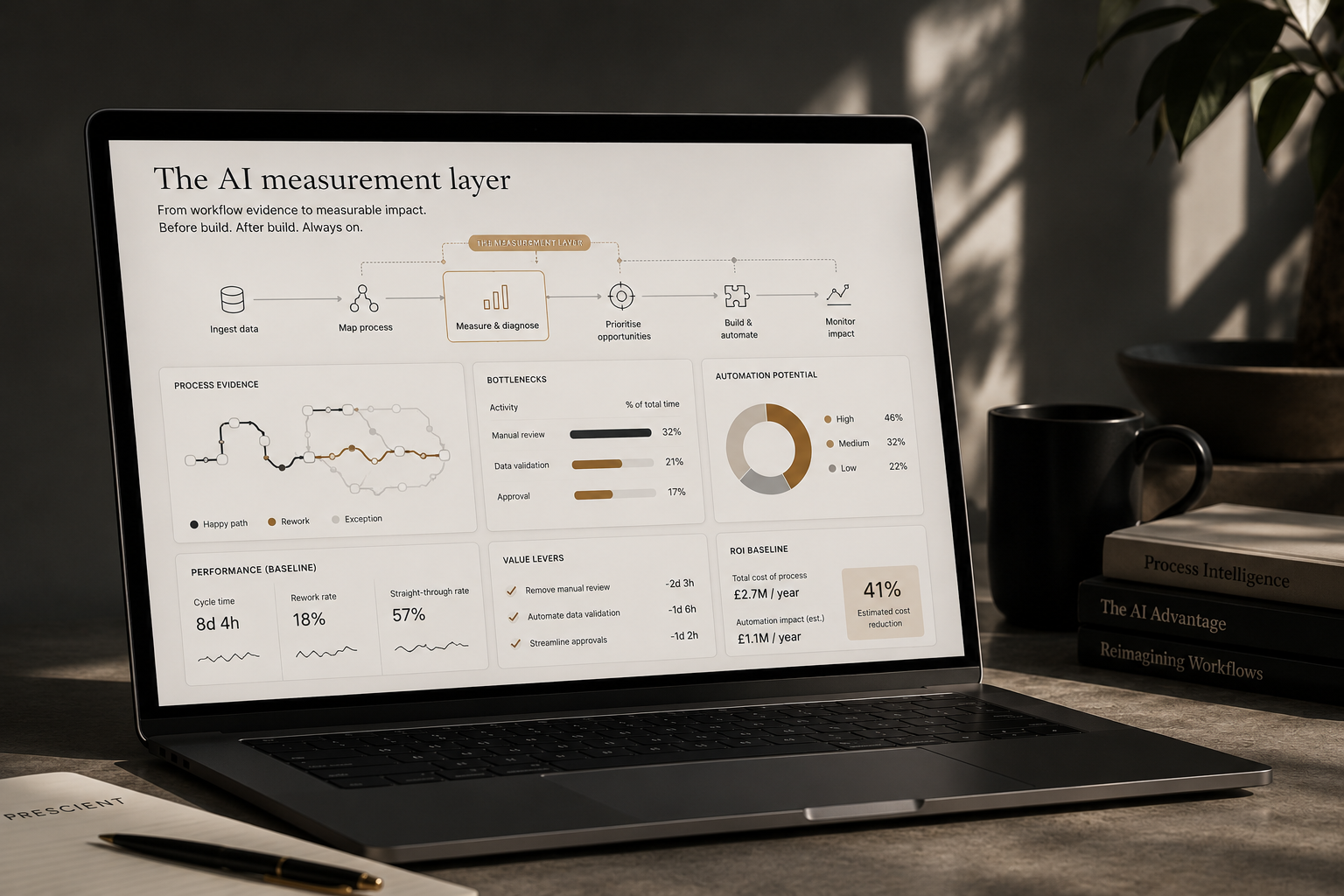
The operating gap underneath AI
I read Deloitte AI Institute's recent piece on enterprise AI transformation and found it useful because it is not really about AI hype.
It is about the operating gap underneath AI.
The piece is based on polling nearly 3,700 professionals and focuses on work redesign, AI governance and ROI measurement. The argument is simple: most organisations are now beyond asking whether AI can be deployed, but many have not changed the way work actually gets done.
That distinction matters.
A company can roll out copilots, give people access to AI tools, run pilots and still be nowhere near transformation.
That feels right.
A lot of AI programmes still start with the visible layer: Which use cases should we prioritise? Which tool should we use? Which teams should get access first? How do we get adoption up?
Those are not bad questions. They are just not the first questions I would ask if the goal is measurable transformation.
Why workflow evidence comes first
The earlier question is: what does the workflow actually look like today?
Not the version in the process document. Not the version from the workshop. The real version.
Where does work wait? Where does rework happen? Which cases follow the expected path and which ones do not? Which approvals slow things down? Which exceptions consume the most time? Which steps have enough volume to justify intervention?
Without that view, AI can easily be layered onto a process that should have been redesigned first.
Deloitte makes a similar point when it says that typical enterprise AI adoption metrics, such as copilots rolled out, employees with access, logins and usage, are a poor proxy for transformation. It also makes the point that if AI is layered onto pre-AI process maps, organisations may only capture part of the value.
That is the part I think is most important.
AI adoption is not the same as process change. Usage is not the same as value. A pilot is not the same as an operating model.
Autonomy is a workflow question
The second useful part of the article is the governance section.
I think this is less about organisations being slow and more about them not having enough operational evidence to trust the next step.
Autonomy is not just a model question. It is a workflow question.
In a finance process, for example, the question is not "can an agent do this task?" The question is more specific.
Is this step reversible? Is the exception rate high? Does this action affect reporting, cash, revenue recognition or auditability? Should a human approve every action or only audit a sample? What would we need to measure before increasing autonomy?
That kind of decision cannot be made well from a generic AI policy. It needs process context.
It needs to be clear where the action sits in the workflow, what risk it carries, what happens when it fails and what evidence would justify changing the guardrails.
This is especially relevant in finance and operations. A lot of AI companies avoid finance because it is harder. The data is sensitive. The tolerance for error is lower. The workflows are full of controls. People are nervous about "touching the numbers".
But that is exactly why finance is such an important proving ground.
If AI transformation is going to become board-level and CFO-relevant, it has to move beyond low-risk productivity experiments. It has to show that it can improve cycle time, throughput, exception handling and decision quality in workflows that matter.
ROI needs a baseline
The third part of the Deloitte article I found useful was on ROI measurement.
That gap is the commercial issue.
A lot of AI business cases are still too soft. They rely on estimated hours saved, assumed productivity uplift or broad strategic value. That may be enough to get a pilot approved, but it is not enough to make AI transformation repeatable.
For PE-backed businesses, it is even more important.
The question is not just whether AI is interesting. The question is where it can create value quickly, how that value will be measured and whether the improvement can be evidenced later.
If there is no baseline before the intervention, it becomes difficult to prove the improvement after the fact.
The missing diagnostic layer
This is where I think a diagnostic layer is missing in a lot of AI transformation work.
Before reimagining the process, you need to see the process. Before selecting the automation, you need to know where the bottleneck is. Before promising ROI, you need a baseline.
At Prescient Labs, this is the problem we are focused on.
We help consultants turn workflow data into evidence they can use before AI build: process maps, bottleneck analysis, automation shortlists and ROI baselines.
The point is not to replace the consultant or own the whole transformation stack. The build layer might be Power Automate, UiPath, Blue Prism, an internal team or another AI platform.
The missing piece is earlier.
It is the quantified view of how work actually moves, where value is leaking and where AI is most likely to create a measurable improvement.
That is why I found the Deloitte piece useful. It makes a clear distinction between AI being present in an organisation and AI changing the operating model.
That distinction is going to matter more over the next year.
The companies that look successful because they have lots of AI activity may not be the ones that create the most value.
The better test will be whether they can show what changed in the workflow, what improved and what evidence supports that claim.